Not all of Jamaica's story at Jazz Fest 2026 was told on a stage. Some of it was told at a workbench. Some of it on a canvas. Some of it in the quiet, deliberate movement of a hand pulling thread through fabric, or a brush meeting wood with the confidence of someone who has done this ten thousand times before.
The Cultural Exchange Artist Demonstration Tent was exactly what its name suggests: a space where art was not displayed behind glass but demonstrated, explained, shared, and in many cases, created live in front of anyone curious enough to stop and watch. And at Jazz Fest 2026, people stopped. They watched. They asked questions. They stayed longer than they intended. Because what was happening in that tent was not a performance. It was Jamaica at work.
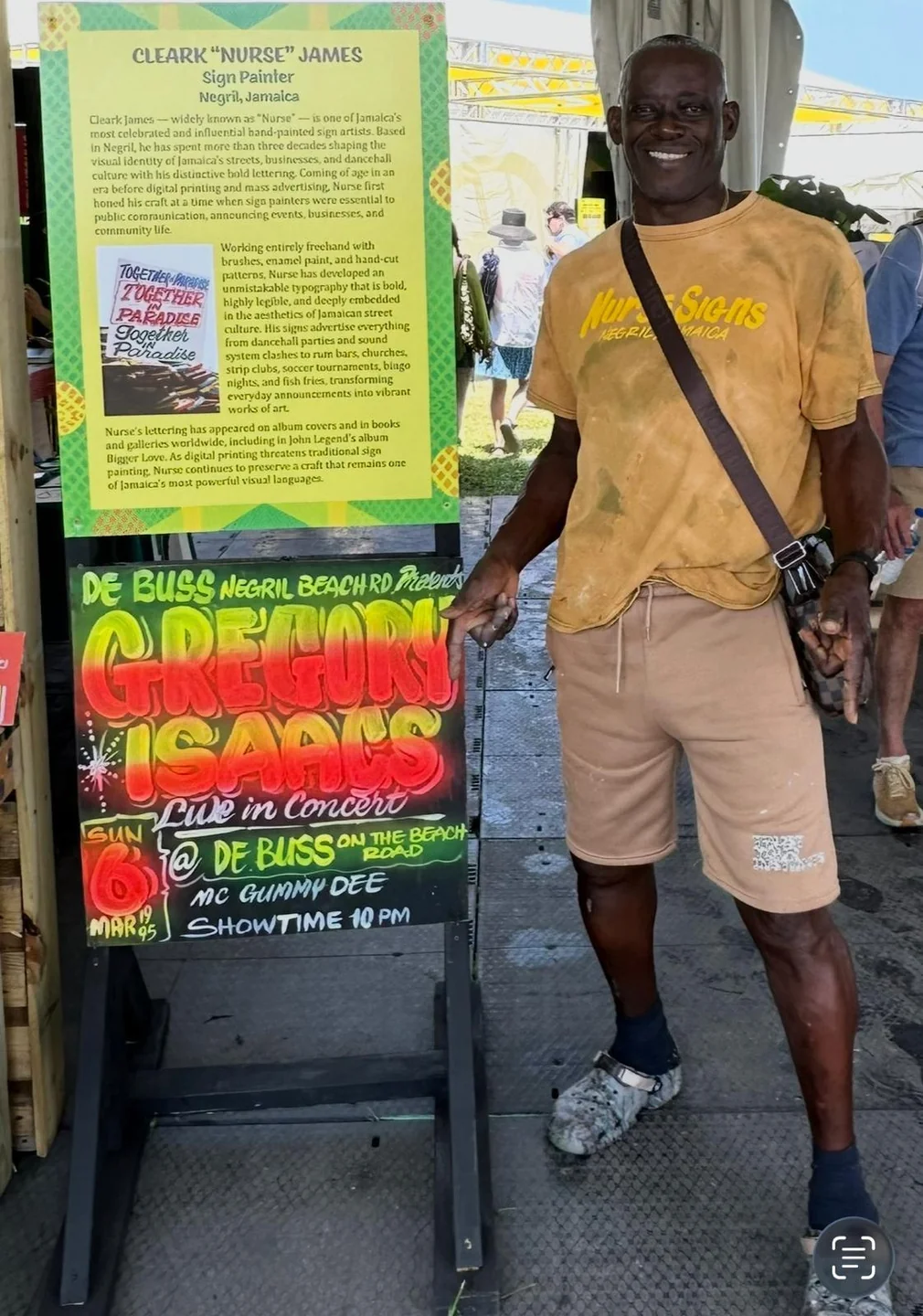
Cleark "Nurse" James: Thirty Years of Bold Letters
For over three decades, Cleark James, known universally as Nurse, has been shaping the visual identity of Jamaica's streets from his base in Negril. His hand-painted signs — bold lettered, color saturated, and alive with the energy of the communities they advertise — have earned him a cult following that stretches from Japan to the United States to Europe, where collectors seek out his work as both art and cultural artifact.
At Jazz Fest 2026, Nurse brought that three-decade tradition to the Fair Grounds. Watching him work is to understand immediately that sign painting is not simply a trade. It is a visual language, one that Jamaica developed organically, outside the formal art world, on roadsides and telephone poles and the sides of buildings, in response to the needs of communities that needed to communicate with color and confidence. When he arrived at Jazz Fest, Nurse said it simply: "Respect to the Jazz Fest family. I was called upon. I'm very happy to be here. When they say Jamaica, I am Jamaican."
Rushane "Bug" Drummond: Born to Paint
Born and raised near Savanna-la-Mar in Westmoreland, Rushane Drummond, known as Bug, grew up surrounded by Jamaica's visual texture: the typography of hand-painted shopfronts, the murals of dancehall culture, the vernacular poetry of roadside messages. Art, he has said, runs in the family. His older brother was the first to put a brush in his hand.
He went on to apprentice under respected local artists, graduating with a CXC in visual arts before launching his career as an independent sign painter in 2009. Today the streets of western Jamaica are, in the truest sense, a gallery of his work. His bold hand-painted dancehall posters, party boards, and commercial signs combine vibrant color, hand-lettered typography, and energetic graphic motifs that stop traffic, literally, on Jamaican roadsides.
At Jazz Fest 2026, Bug brought another dimension of his work to the demonstration tent: his hand-painted Ludi boards. Ludi, a popular Caribbean board game similar to Parcheesi, is as embedded in Jamaican community life as the music and the food. Bug demonstrated how to play throughout the festival, turning the art demonstration into something interactive, warm, and completely Jamaican in spirit. You came to watch an artist. You stayed for a game.
Taj Francis: Jamaica Through a Surrealist Lens
Taj Francis does not paint signs. He builds worlds. A prolific illustrator, animator, and graphic designer whose large-scale murals can be seen across the globe, Francis was born and raised in Kingston and trained at the Edna Manley College of the Visual and Performing Arts, Jamaica's most celebrated arts institution. His work focuses on exploring African-Caribbean identity through a surrealist lens, creating vivid and symbolic visuals that investigate cultural memory, mythology, and the contemporary Black experience.
His client list reads like a who's who of global creative culture: HBO, Universal Studios, Samsung, and recording artist Protoje, whose own musical vision of Jamaica's identity aligns naturally with Francis's visual one. His work has been featured in Vanity Fair and Vice. His murals appear on walls across multiple continents. At Jazz Fest 2026, Francis performed live painting in the demonstration tent, creating work in real time in front of festival-goers who may never have encountered this dimension of Jamaican visual art before. To watch Taj Francis work is to understand that Jamaica's creative legacy does not begin and end with music. It lives in every medium her artists choose to inhabit.
Kokab Zohoori-Dossa: Where Ancestral Craft Meets Contemporary Vision
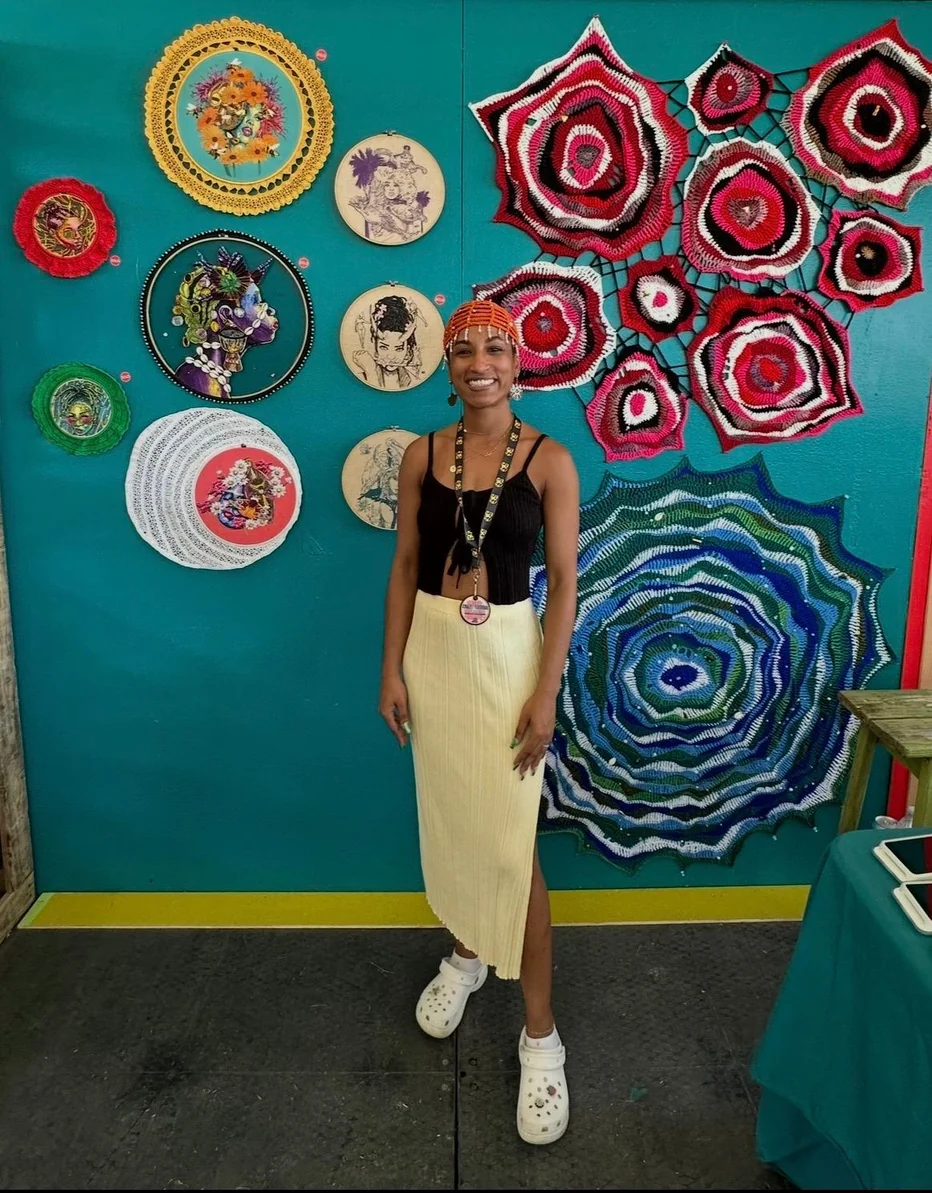
Kokab Zohoori-Dossa is a multidisciplinary artist from Kingston, Jamaica, born to an Iranian mother and a West African father, whose layered heritage informs every thread of her work. Trained as an illustrator, digital artist, painter, and graphic designer, her current fine art practice has turned toward textiles: working with embroidery, crochet, fabric, and beadwork to explore how traditional crafts and ancestral themes can translate into expressive and contemporary art.
Her wall textile display at the Cultural Exchange Artist Demonstration Tent was one of the tent's most visually arresting moments. Large scale, richly textured, and deeply rooted in cultural memory, her work asked the same question that the entire pavilion was asking in different ways: what does it mean to carry your heritage in your hands? For Kokab, the answer is woven into every piece she makes.
A Tent Full of Jamaica
Taken together, these four artists represent something that no stage performance, however extraordinary, can fully capture: the breadth of Jamaica's creative identity. From dancehall signs to surrealist murals, from hand-painted Ludi boards to textile installations, the Cultural Exchange Artist Demonstration Tent offered a portrait of an island whose creativity does not fit in a single category, a single genre, or a single medium.
Jamaica does not have one way of telling her story. She has as many ways as she has people willing to pick up a brush, a thread, a board, a camera or a pen and begin.
The tent was proof of that. Every day. Both weekends. Rain and all.
Faces of Heritage: Patrick Planter
Patrick Planter is a Jamaican photographer who began his career documenting sports, entertainment, and everyday life for The Jamaica Gleaner before relocating to Switzerland in 2017. Trained in documentary photography, he focuses on portraiture, using simple, striking compositions to capture the people and everyday scenes that shape life in Jamaica.
His exhibition at the Sandals Resorts Jamaica Cultural Exchange Pavilion, titled Faces of Heritage, presented a selection of photographs that reflect pride and identity in Jamaican life. From Jah Lloyd and the Oracabessa Elder to a St. Ann fisherman and the cascading waters of Avocal Falls in Portland, from market vendor Donnette Zacca to performer Popcaan at Summerjam 2019, Planter's lens finds dignity and beauty in the faces and landscapes that Jamaica sometimes takes for granted. His work reminds the world, and Jamaica herself, of exactly who she is.